
Please complete the form below



The great period of “the Discoveries” accounted for phenomenal wealth brought back from India, Africa and Brazil by the great Portuguese navigators. Gold, jewels, ivory, porcelain and spices helped finance grand new buildings and impressive monuments in Lisbon, the country’s capital city. As you sail up the Tagus River, be on deck to admire Lisbon’s panorama and see some of the great monuments lining the river. Lisbon is one of Europe’s smallest capital cities but considered by many visitors to be one of the most likeable. Spread over a string of seven hills, the city offers a variety of faces, including a refreshing no-frills simplicity reflected in the people as they go unhurriedly through their day enjoying a hearty and delicious cuisine accompanied by the country’s excellent wines.
The commercial center of northern Portugal and hub of the port wine trade, Porto is a gracious, cosmopolitan city noted for its 12th century cathedral and medieval churches, picturesque narrow streets and wine lodges at Vila Nova de Gaia. It is clustered on hills overlooking a river, and is a northern European style city with granite church towers, narrow streets and hidden Baroque treasures.
Straddling the banks of an estuary opening into the Bay of Biscay, Bilbao is the largest city in Spain’s northeastern Basque Country. Its earliest beginnings are preserved in the Casco Viejo, seven medieval streets that used to be guarded by walls. There visitors will find the city’s old churches, a large market, a public theater and the Academy of the Basque Language. Nearby sources of iron ore made Bilbao an important industrial and shipping center from the 14th century onward. The Spanish Civil War also started here. Today the city is being transformed by a growing service economy, and its prominence on the global traveler’s radar may be dated from the 1997 inauguration of the striking Frank Gehry-designed Guggenheim Museum Bilbao. In fact, the estuary town has become a veritable magnet for architects, boasting notable masterworks including Santiago Calatrava’s beautiful Zubizuri (“White Bridge” in Basque) and airport complex, the 541-foot Iberdrola Tower by the Argentine Cesar Pelli, a subway system by Norman Foster, the 1909 wine warehouse called Alhóndiga, converted a century later by designer Philippe Starck and the Euskalduna Conference Centre and Concert Hall by Federico Soriano and Dolores Palacios. The Zorrozuarre area is also being redeveloped, following a 2007 master plan by the Iraqi architect Zaha Hadid. For views of all of this, take the funicular from the city center to the top of Mt. Artxanda, where a sports complex, restaurants and a balcony await you.
Located on the southeastern curve of the Bay of Biscay, St-Jean and Biarritz are the most important resorts on the Cote Basque. The French/Spanish alliance was cemented when Cardinal Mazarin arranged the marriage of Louis XIV to Maria-Teresa, the Infanta of Spain, in St. Jean-de-Luz. Biarritz made in the international must-do list when the Empress Eugenie built her palace there is 1854. Since then, it has attracted a seemingly endless list of crowned heads and tycoons, drawn by the pleasant climate, the broad sandy beaches and the casinos that thrive here.
Saint-Malo is a port city in Brittany, in France’s northwest. Tall granite walls surround the old town, which was once a stronghold for privateers (pirates approved by the king). The Saint-Malo Cathedral, in the center of the old town, is built in Romanesque and Gothic styles and features stained-glass windows depicting city history. Nearby is La Demeure de Corsaire, an 18th-century privateer’s house and museum.
Portsmouth is a port city and naval base on England’s south coast, mostly spread across Portsea Island. It’s known for its maritime heritage and Portsmouth Historic Dockyard. The dockyard is home to the interactive National Museum of the Royal Navy, the wooden warship HMS Victory, where Nelson died in the Battle of Trafalgar, and HMS Warrior 1860. The Tudor ship Mary Rose is also conserved in a dockyard museum.
Crossing the English Channel from continental Europe to Great Britain, the first view of England is the milky-white strip of land called the White Cliffs of Dover. As you get closer, the coastline unfolds before you in all its striking beauty. White chalk cliffs with streaks of black flint rise straight from the sea to a height of 350’ (110 m).
Numerous archaeological finds reveal people were present in the area during the Stone Age. Yet the first record of Dover is from Romans, who valued its close proximity to the mainland. A mere 21 miles (33 km) separate Dover from the closest point in France. A Roman-built lighthouse in the area is the tallest Roman structure still standing in Britain. The remains of a Roman villa with the only preserved Roman wall mural outside of Italy are another unique survivor from ancient times which make Dover one of a kind.
Founded in 997, Trondheim is one of Norway’s oldest cities, situated midway between southern and northern Norway. Dominated by the massive Nidaros Cathedral, Trondheim is often referred to as the Royal City. Traditionally, the kings of Norway have been crowned in the cathedral, which is considered a National Shrine.Straddling both sides of the River Nid, on Trondheimfjord, much of the town was rebuilt after a disastrous fire in 1681 destroyed the majority of its original wooden structures. Some of the oldest buildings, dating to the 1700s, have survived along the river, while the wide streets of the city center boast picturesque and brightly painted houses.Apart from the imposing cathedral, other points of interest include the Museum of Applied Art and Craft with one of the finest collections in Scandinavia, and Stiftsgaarden, the largest wooden structure in the country. Built in 1778 as a private home, it is now the King’s official residence in Trondheim. The Royal Garden Hotel located on the river, features the same Hansa architecture as the old warehouses that line the waterfront – only in glass and concrete. It is the city’s showcase hostelry.
A coastal city, Brønnøysund’s origin dates back to its 13th century Viking heritage. In the intervening centuries, it has been settled by immigrants from southern Norway and Sweden, and its local Swedish-like dialect still carries echoes of this past.
Brønnøysund sits on a narrow peninsula from the mainland, is surrounded by waterways dotted with a maze of small scenic islands. In this fairytale setting, picturesque, colorful houses are set amidst thick lush greenery, turquoise blue water and shallow bays. Towering above the town like a giant troll’s hat is the massive granitic monolith of Torghatten Mountain. Here can be found one of the great natural curiosities of the area, a 520’ (160 m) hole piercing completely through the center of the mountain. The Viking sagas surmised that it was the impact of a warrior horseman’s arrow that created the wound. However, it was actually formed during the last Ice Age by erosion from ice and water.
Huddled together in what appears to be a wall of solid rock, the Lofotens are actually several islands. Their scenery, revealed when the ice disappeared from the last Ice Age, is held to be among the most dramatic in Norway. Svolvaer, located on the island of Austvaagoey, received town status in 1996, and is the Lofotens’ most important city with about 4,500 residents. Dominating the town is the mountain peak called Svolvaergeita, a beacon for climbers. Fishermen flock here when the Norwegian Arctic cod enters the Vestfjord to spawn. Artists prize the picturesque setting and extraordinary light conditions.
Many a polar expedition has begun from Tromso. The town was founded in 1794, but its roots go back to Hanseatic and, even earlier to Viking times. Situated inside the Arctic Circle on the forest-clad island of Troms, this spirited city is linked to the mainland by the spectacular Tromsobrua Bridge, built in 1960. During WWII, Tromso was one of the few places in northern Norway to escape bombing, and a number of old wood buildings still remain. At the Tromso Museum, the exhibits include an extensive display on the people of Lapland. The town also boasts both the world’s northernmost university and brewery.
The perpendicular cliffs of Nordkapp, or the North Cape, mark the very top of the European continent. This ultimate destination has long drawn adventurous royalty including Oscar II, King of Norway and Sweden, who visited in 1873, and followed by the King of Siam in 1907. The North Cape is located on the island of Mageroey, a name derived from a word that means “meager.” While the landscape may have a lunar appearance, it is not really so isolated. Just 21 miles away, the main town, Honningsvåg, has some 4,000 inhabitants. In summer that number swells when the Sami people and their reindeer settle on the outskirts of town.
Olden is a village and urban area in the municipality of Stryn in Vestland county, Norway. Olden is located at the mouth of the Oldeelva river at the northern end of the Oldedalen valley on the southern shore of the Nordfjorden.
With its mountain backdrop and painted wood houses, Norway’s second-largest city is one of the country’s most appealing places. In the 14th century, the port of Bergen was a Hanseatic trading center and for a time, the country’s capital. The buildings on Bryggen, as the Hanseatic Wharf is called, are collectively a UNESCO designated World Heritage Site. The harbor-side market, the lovely parks and the shopping district are all best suited to explore on foot. Take a ride on a funicular up to the 1,050-foot-high Floeien lookout, or head to 13th-century Bergenhus Fortress and 16th-century Rosenkrantz Tower to feel transported back in time.
The delightfully attractive city of Amsterdam is home to many of the world’s great art treasures, and is a major center of the glamorous diamond trade as well. Unique architectural styles of the past blend with superb modern structures, and the web of curved and straight canals makes the city as easy to traverse by water as by land. The hospitality of the local people has been remarked upon by generations of travelers, and the Dutch’s respect for and tolerance of the beliefs of others has attracted refugees from around the world for centuries.
Crossing the English Channel from continental Europe to Great Britain, the first view of England is the milky-white strip of land called the White Cliffs of Dover. As you get closer, the coastline unfolds before you in all its striking beauty. White chalk cliffs with streaks of black flint rise straight from the sea to a height of 350’ (110 m).
Numerous archaeological finds reveal people were present in the area during the Stone Age. Yet the first record of Dover is from Romans, who valued its close proximity to the mainland. A mere 21 miles (33 km) separate Dover from the closest point in France. A Roman-built lighthouse in the area is the tallest Roman structure still standing in Britain. The remains of a Roman villa with the only preserved Roman wall mural outside of Italy are another unique survivor from ancient times which make Dover one of a kind.
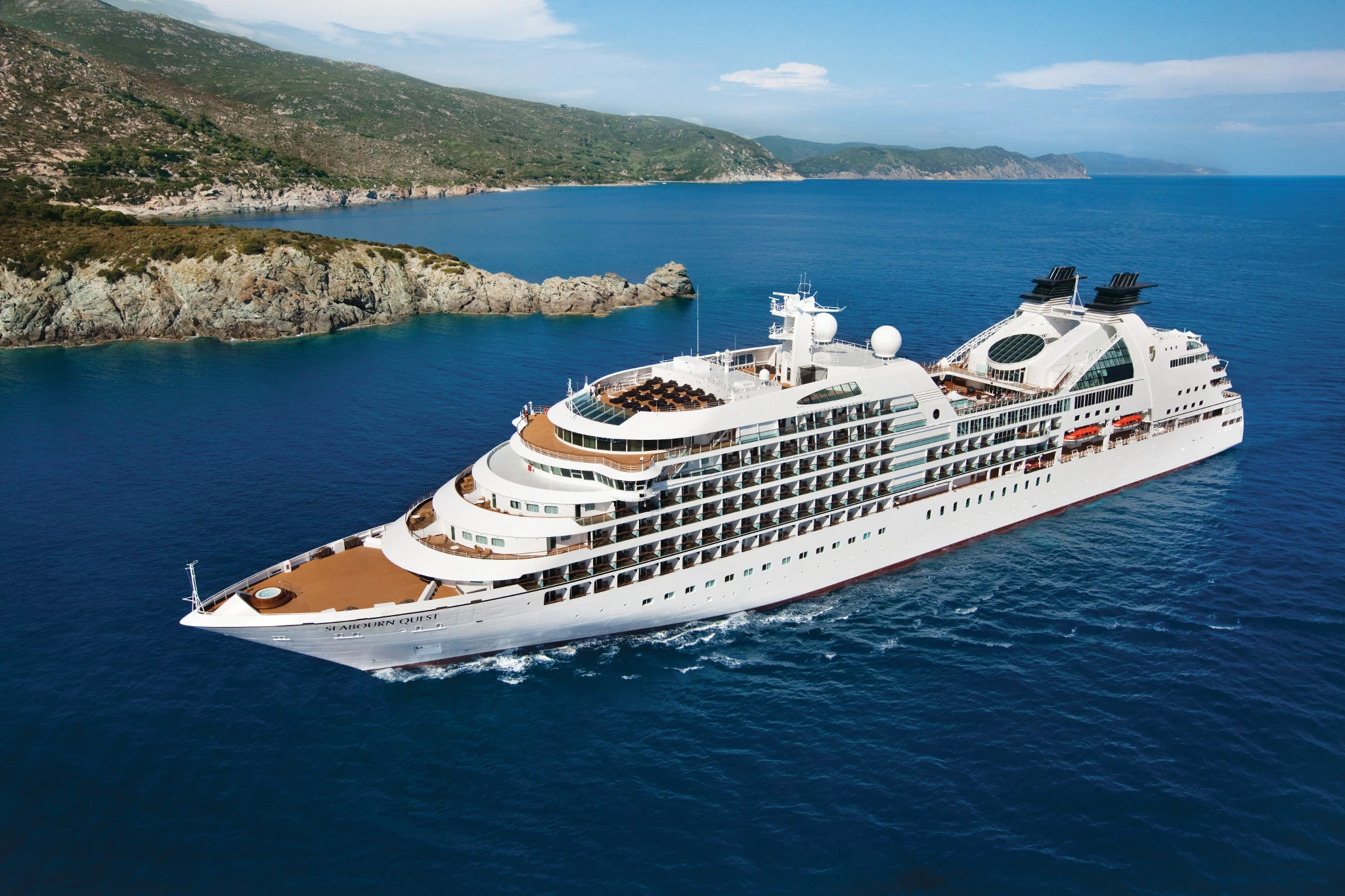
Seabourn Quest is the third iteration of the vessel design that has been called “a game-changer for the luxury segment.” True to her Seabourn bloodlines, wherever she sails around the world, Seabourn Quest carries with her a bevy of award-winning dining venues that are comparable to the finest restaurants to be found anywhere. Seabourn Quest offers a variety of dining options to suit every taste and every mood, with never an extra charge.
Internet Cafe
Bar
Mariners Patio Bar
Patio Grill
Patio Lounge
Sky Bar
The Colonnade
The Grill (burgers & hot dogs)
The Restaurant
The Restaurant 2
Living Room
Shopping Gallery
Fitness Center
Gym
Wellness Centre
Greenhouse Spa & Salon
Massage
Spa
Swimming Pool
Whirlpool
Casino
Entertainment Team
Gaming Club Casino
Theatre
9-hole Mini Golf
Card Room
Library
Water Sports Marina
Please complete the form below