
Please complete the form below



Denmark’s capital is arguably one of the world’s best-loved cities, and certainly the liveliest of all the Scandinavian capitals. It is a gracious and comfortable place, with a decidedly friendly, hospitable and fun-loving atmosphere. If there is such a thing as a cozy city, Copenhagen is it. From the lingering memory of the tales of Hans Christian Andersen to the colored lights of Tivoli Gardens, there is a delightful ambience that surrounds the visitor everywhere. Tidy, narrow streets are lined with tempting restaurants and cafes, and the pedestrian-only Stroget abounds with stylish shops. The spirited Copenhageners are imaginative and unconventional and exude a “do-what-you-want” philosophy that embraces and respects almost all aspects of life. Every friendly Dane you meet further illustrates the city’s motto “Wonderful, wonderful, Copenhagen.”
Denmark’s capital is arguably one of the world’s best-loved cities, and certainly the liveliest of all the Scandinavian capitals. It is a gracious and comfortable place, with a decidedly friendly, hospitable and fun-loving atmosphere. If there is such a thing as a cozy city, Copenhagen is it. From the lingering memory of the tales of Hans Christian Andersen to the colored lights of Tivoli Gardens, there is a delightful ambience that surrounds the visitor everywhere. Tidy, narrow streets are lined with tempting restaurants and cafes, and the pedestrian-only Stroget abounds with stylish shops. The spirited Copenhageners are imaginative and unconventional and exude a “do-what-you-want” philosophy that embraces and respects almost all aspects of life. Every friendly Dane you meet further illustrates the city’s motto “Wonderful, wonderful, Copenhagen.”
Although Helsingborg appears small and quaint, it actually has a rich history and emerges for the first time in 10th century sagas. Since then it has been the site of many battles between Denmark and Sweden. Incorporated into Sweden in 1658 it was totally destroyed by the Danes in 1710. After the city was rebuilt, Jean-Baptiste Bernadotte, the founder of the Swedish royal dynasty, landed here in 1810. The town’s attractions include the surviving center tower (the Keep) of Helsingborg Castle and the Town Hall, which has a small museum featuring exhibits about the city and the region. The Grand Hotel, one of Sweden’s oldest hotels, is known for its excellent dining room. A stroll along the pedestrian mall is a delightful way to pass some time. Please be aware that most shops are normally closed on Sunday.
Historically, Lysekil was mainly known as a bathing location in Sweden in the 19th century, due to its popular bathing house dating from 1847. Once again, Lysekil is a popular summer resort located in Sweden’s Bohuslän province and one of the sunniest places on the Scandinavian peninsula. Because of its favorable weather and picturesque archipelago dotted with small islands and protected fjord-like water ways it attracts many yachts and sun worshipers from the North who annually flock to their summer cottages in this area. Along with fishing, which is featured in its coat of arms, tourism has become important to Lysekil’s economy.
Norway’s capital lies at the head of the majestic Oslofjord, encircled by wooded hills and snowcapped peaks. Dating back to the mid-11th century, it was at one time renamed Christiania while under Danish and Swedish rule. An act of Parliament finally changed the name back to Oslo in 1925. With barely half a million inhabitants, Oslo is the smallest among the Scandinavian capitals. Yet it has much to offer – most notably its spectacular scenic beauty, as well as many of the nation’s finest cultural achievements.
Arriving by ship, your first sight is the imposing Akershus Fortress towering above the docks. With the city center only a few blocks from the pier, you can easily spot the handsome modern City Hall with its two block towers. Dedicated in 1950 to commemorate Oslo’s 900-year anniversary, it is the city’s most familiar landmark. Many of Norway’s leading artists contributed to the decoration of the interior and as a result Socialist modernism in its purest form can be seen here. More extraordinary art works can be admired at Frogner Park, site of the famous Vigeland sculptures depicting a world of human beings and animals in stone. Fine examples of Scandinavian impressionists, referred to as the “Northern Light” artists, are exhibited in the National Gallery. The Munch Museum houses an enormous collection of art bequeathed to the city by Norway’s leading artist Edvard Munch. Most of Oslo’s historic sites are concentrated on the Bygdoe Peninsula; the Norwegian Folkmuseum, the Viking Ship Museum, the Fram, and the Kon-Tiki Museums are outstanding.
Farsund is located on the Lista Peninsula in southern Norway, which is filigreed with fjords and waterways such as the Lygdalsfjorden. It is a popular attraction for vacationers for its beaches and prolific birdlife, as well as hiking trails and historic events such as the pirate festival. The Vanse Church is one of Norway’s earliest, dating from 1037. The town was also an important part of the Atlantic Wall in WWII, with bunkers and fortifications such as the Nordberg Fortress, and nearby islands used as prisons for captured Axis soldiers. The Lista Lighthouse is a popular place to watch birds and get views over the beaches.
A Romanesque cathedral and old medieval lanes blend beautifully with Stavanger’s modern city and spectacular countryside. In 872, when Harald Fairhair won the Battle of Hafrsfjord near Stavanger, he united Norway for the first time. Huge harvests of brisling, herring and sardines have made the key of a sardine can the city symbol. Today, the town is the center of Norway’s oil industry, and has become one of the country’s most cosmopolitan cities.
The residents of Hamburg have retained the independent spirit which earned this autonomous commercial center its ‘Free City’ designation in the Middle Ages. One of Germany’s principal ports, Hamburg is surrounded by enormous dock areas and the gaudy, licentious Reeperbahn (which translates loosely to ‘Anchorage of Joy’) is fully prepared to offer every form of entertainment to the world’s sailors. The vaudeville acts at the Hansa-Theater are bright and clever (and language is no barrier). The Kunsthalle (art museum) boasts an outstanding collection of 16th- and 20th-century masterpieces, and the Renaissance Rathaus (city hall) sits atop some 4,000 piles driven into marshy ground proving that the engineers of Hamburg have been skilled and imaginative for centuries.
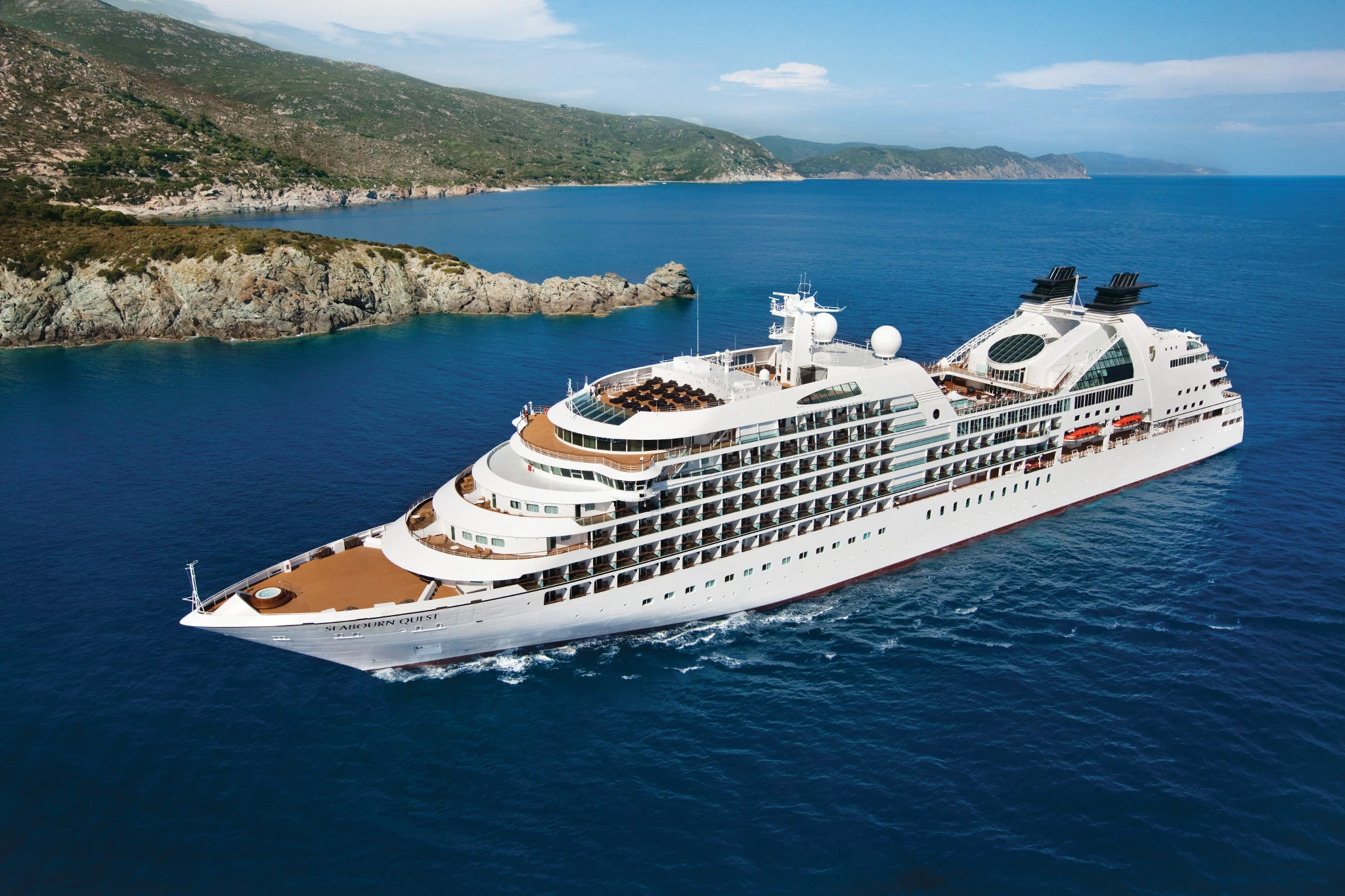
Seabourn Quest is the third iteration of the vessel design that has been called “a game-changer for the luxury segment.” True to her Seabourn bloodlines, wherever she sails around the world, Seabourn Quest carries with her a bevy of award-winning dining venues that are comparable to the finest restaurants to be found anywhere. Seabourn Quest offers a variety of dining options to suit every taste and every mood, with never an extra charge.
Internet Cafe
Bar
Mariners Patio Bar
Patio Grill
Patio Lounge
Sky Bar
The Colonnade
The Grill (burgers & hot dogs)
The Restaurant
The Restaurant 2
Living Room
Shopping Gallery
Fitness Center
Gym
Wellness Centre
Greenhouse Spa & Salon
Massage
Spa
Swimming Pool
Whirlpool
Casino
Entertainment Team
Gaming Club Casino
Theatre
9-hole Mini Golf
Card Room
Library
Water Sports Marina
Please complete the form below