
Please complete the form below



Crossing the English Channel from continental Europe to Great Britain, the first view of England is the milky-white strip of land called the White Cliffs of Dover. As you get closer, the coastline unfolds before you in all its striking beauty. White chalk cliffs with streaks of black flint rise straight from the sea to a height of 350’ (110 m).
Numerous archaeological finds reveal people were present in the area during the Stone Age. Yet the first record of Dover is from Romans, who valued its close proximity to the mainland. A mere 21 miles (33 km) separate Dover from the closest point in France. A Roman-built lighthouse in the area is the tallest Roman structure still standing in Britain. The remains of a Roman villa with the only preserved Roman wall mural outside of Italy are another unique survivor from ancient times which make Dover one of a kind.
Founded in 997, Trondheim is one of Norway’s oldest cities, situated midway between southern and northern Norway. Dominated by the massive Nidaros Cathedral, Trondheim is often referred to as the Royal City. Traditionally, the kings of Norway have been crowned in the cathedral, which is considered a National Shrine.Straddling both sides of the River Nid, on Trondheimfjord, much of the town was rebuilt after a disastrous fire in 1681 destroyed the majority of its original wooden structures. Some of the oldest buildings, dating to the 1700s, have survived along the river, while the wide streets of the city center boast picturesque and brightly painted houses.Apart from the imposing cathedral, other points of interest include the Museum of Applied Art and Craft with one of the finest collections in Scandinavia, and Stiftsgaarden, the largest wooden structure in the country. Built in 1778 as a private home, it is now the King’s official residence in Trondheim. The Royal Garden Hotel located on the river, features the same Hansa architecture as the old warehouses that line the waterfront – only in glass and concrete. It is the city’s showcase hostelry.
A coastal city, Brønnøysund’s origin dates back to its 13th century Viking heritage. In the intervening centuries, it has been settled by immigrants from southern Norway and Sweden, and its local Swedish-like dialect still carries echoes of this past.
Brønnøysund sits on a narrow peninsula from the mainland, is surrounded by waterways dotted with a maze of small scenic islands. In this fairytale setting, picturesque, colorful houses are set amidst thick lush greenery, turquoise blue water and shallow bays. Towering above the town like a giant troll’s hat is the massive granitic monolith of Torghatten Mountain. Here can be found one of the great natural curiosities of the area, a 520’ (160 m) hole piercing completely through the center of the mountain. The Viking sagas surmised that it was the impact of a warrior horseman’s arrow that created the wound. However, it was actually formed during the last Ice Age by erosion from ice and water.
Many a polar expedition has begun from Tromso. The town was founded in 1794, but its roots go back to Hanseatic and, even earlier to Viking times. Situated inside the Arctic Circle on the forest-clad island of Troms, this spirited city is linked to the mainland by the spectacular Tromsobrua Bridge, built in 1960. During WWII, Tromso was one of the few places in northern Norway to escape bombing, and a number of old wood buildings still remain. At the Tromso Museum, the exhibits include an extensive display on the people of Lapland. The town also boasts both the world’s northernmost university and brewery.
The perpendicular cliffs of Nordkapp, or the North Cape, mark the very top of the European continent. This ultimate destination has long drawn adventurous royalty including Oscar II, King of Norway and Sweden, who visited in 1873, and followed by the King of Siam in 1907. The North Cape is located on the island of Mageroey, a name derived from a word that means “meager.” While the landscape may have a lunar appearance, it is not really so isolated. Just 21 miles away, the main town, Honningsvåg, has some 4,000 inhabitants. In summer that number swells when the Sami people and their reindeer settle on the outskirts of town.
A large columnar monument atop a small seaside hill at Haraldshaugen, near the town of Haugesund, commemorates the birthplace of Norway. In fact, the hill is the burial mound of Norway’s first king, Harald Fairhair, who ruled from A.D. 872 to 930 during the height of the Viking age. This homeland of Viking kings has a lot to offer visitors– fjords, mountains, waterfalls, glaciers, culture, idyllic islands and a unique Norse heritage.
The Dokken Open Air Museum features thematic exhibitions of life during Haugesund’s herring fishing heyday of the 1800s, while the Karmsund Folkemuseum highlights the area’s maritime culture and heritage. Visiting the Arquebus War History Museum, you will be impressed by the quality and variety of the museum’s collection of World War II tanks and military equipment. A highlight in Haugesund for many people is the Vintage Car Museum. Norway’s largest private car collection, with nearly 200 renovated and functioning vehicles, it is located in Frakkagjerd just outside Haugesund.
Farsund is located on the Lista Peninsula in southern Norway, which is filigreed with fjords and waterways such as the Lygdalsfjorden. It is a popular attraction for vacationers for its beaches and prolific birdlife, as well as hiking trails and historic events such as the pirate festival. The Vanse Church is one of Norway’s earliest, dating from 1037. The town was also an important part of the Atlantic Wall in WWII, with bunkers and fortifications such as the Nordberg Fortress, and nearby islands used as prisons for captured Axis soldiers. The Lista Lighthouse is a popular place to watch birds and get views over the beaches.
As one of the important cultural hubs of Denmark, Aalborg is known for its mixture of contemporary architecture, traditional wooden Danish houses, and the many preserved stone buildings in its historical city center. A number of large city parks, fountains, a gothic cathedral and a colorful waterfront make Aalborg a favorite vacation spot. Square-rigged heritage sailing ships make a contrast with numerous architectural masterpieces such as the ultra-modern designs of the Utzon Center and the University of Aalborg. The Aalborg Carnival, one of Scandinavia’s largest festivals, takes place every year in May and draws tens of thousands of participants. The Kunsten Museum of Modern Art exemplifies the creativity and energy of this beautiful Danish city.
Situated at the narrowest point of Limfjord in Jutland, Aalborg abuts some of the richest waterways in the country, which attracted not only the original Viking adventurers to the area, but settlers as far back as the Iron Age.
Denmark’s capital is arguably one of the world’s best-loved cities, and certainly the liveliest of all the Scandinavian capitals. It is a gracious and comfortable place, with a decidedly friendly, hospitable and fun-loving atmosphere. If there is such a thing as a cozy city, Copenhagen is it. From the lingering memory of the tales of Hans Christian Andersen to the colored lights of Tivoli Gardens, there is a delightful ambience that surrounds the visitor everywhere. Tidy, narrow streets are lined with tempting restaurants and cafes, and the pedestrian-only Stroget abounds with stylish shops. The spirited Copenhageners are imaginative and unconventional and exude a “do-what-you-want” philosophy that embraces and respects almost all aspects of life. Every friendly Dane you meet further illustrates the city’s motto “Wonderful, wonderful, Copenhagen.”
A favorite summer getaway for Danes, Bornholm’s rolling countryside reveals distinctive round white churches and ruined castles. The picturesque seaport of Roenne lies at the southwest corner of this Baltic island whose coastline mixes pearl white sand in the south with sheer granite cliffs to the north. Here you can see four of Denmark’s seven famous round churches dating from the 12th century.
This delightful hilly town, boasting medieval houses and ruined fortifications, is Gotland’s capital city. Due to its gentle climate an abundance of roses bloom here, even as late as November, marking Visby as ‘The City of Roses. In its heyday, Visby was one of the richest trading centers in northern Europe. Remains of the medieval city walls are considered to be among the best-preserved in Europe. Additional points of interest include the cathedral, one of the town’s 17 medieval churches still in use today; the Old Apothecary, a late-medieval four-story merchant’s house; and the Fornsal Museum with an interesting exhibit of medieval artwork, hordes of silver form Viking times, and impressive picture stones that predate the Viking rune stones. Sweden’s main holiday island offers wide sandy beaches, wild cliff formations, and verdant sheepfarming country and glades in which 35 different varieties of wild orchids thrive, attracting botanists from around the world. There are also a hundred more churches dating from Gotland’s great commercial era scattered across the island which are still in use today.
Sweden’s capital has been called the most beautiful city in the world. This “city that floats on water” sprawls over 14 islands that are linked by over 50 bridges, which cross winding waterways in all directions. To the east is an archipelago of thousands of islands in different shapes, sizes and contours. Venice, for all its gondolas, does not approach the water traffic of Stockholm. The hundreds of small boats that line the inlets and canals testify to the passion of every family to own and sail a boat.
Sweden’s capital has been called the most beautiful city in the world. This “city that floats on water” sprawls over 14 islands that are linked by over 50 bridges, which cross winding waterways in all directions. To the east is an archipelago of thousands of islands in different shapes, sizes and contours. Venice, for all its gondolas, does not approach the water traffic of Stockholm. The hundreds of small boats that line the inlets and canals testify to the passion of every family to own and sail a boat.
Helsinki, capital of Finland and “Daughter of the Baltic,” was founded in 1550 and became the capital in 1812. The city is beautifully set on a peninsula surrounded by islands and is protected by fortifications at Suomenlinna. A modern, lively city of approximately a half million inhabitants, Helsinki’s attractions include the harbor, market square and many spacious parks. The Empire Center is one of Europe’s finest examples of neoclassical architecture.
The capital of Estonia, Tallinn was called Reval until the 20th century. The port’s ideal maritime position has always been a temptation to other nations and won it a position in the Hanseatic League. This cross-cultural history gives Tallinn a special ambience that visitors appreciate. The main attraction is the Old Town. Perched on a low hill by the shore, its fortification walls, worn cobbled streets and 13th-century buildings make it one of the purest medieval towns in all of northern Europe. With about a half-million inhabitants, Tallinn comprises almost a third of Estonia’s population. Outside of town there is rich dairy land and along the coast stretch expansive sand beaches.
Riga, situated on a sandy plain about 9 miles from the mouth of the River Dvina, is the capital of Latvia and is one of the most beautiful of the Baltic cities. The advantageous geographical position, with access to both the sea and via the river to the east, shaped both the history and culture of the city. Founded in the 12th century, it was established as a trading settlement and grew quickly into an important port with a remarkable diversity of Gothic, Baroque Renaissance and Classical architectural styles. Today, the capital city is a major tourist attraction while remaining one of the principal ports in the Baltic and a top producer of manufactured goods.
Klaip eda’s history dates back to 1252, when it was founded as a fortress to provide protection against marauders arriving by sea. A member of the Hanseatic League during its heyday, Klaip eda was also ruled at various times by Sweden, Russia, Prussia, Lithuania, Germany, the Soviet Union, and now, once again, Lithuania. With a population of nearly 200,000, Klaip eda is one of Lithuania’s largest cities and most important ports. Be sure to visit Mazvydas Sculpture Park or perhaps make the drive to nearby Palanga or Nida along the Baltic coast. Special Note: Please bear in mind that tourism in Lithuania is still in its infancy. Facilities and guides may not be up to Cunard’s normally high standards.
Historically known as the tinderbox whose spark ignited the WWII, it was also in Gdansk where the flame that signalized the collapse of communism was illuminated. Today, the affectionately restored facades of the town houses lining the streets in the Old Town remind visitors of the heyday of the Hanseatic League and preserve its distinctive charm. Nestled on the banks of the Bay of Gdansk, amid the seaside resort of Sopot and the seaport of Gdynia, the Gdansk area is often referred to as “Tri-City.” The close affiliation to its neighboring cities and its advantageous location make Gdansk the perfect gateway to discover beautiful Poland.
Denmark’s capital is arguably one of the world’s best-loved cities, and certainly the liveliest of all the Scandinavian capitals. It is a gracious and comfortable place, with a decidedly friendly, hospitable and fun-loving atmosphere. If there is such a thing as a cozy city, Copenhagen is it. From the lingering memory of the tales of Hans Christian Andersen to the colored lights of Tivoli Gardens, there is a delightful ambience that surrounds the visitor everywhere. Tidy, narrow streets are lined with tempting restaurants and cafes, and the pedestrian-only Stroget abounds with stylish shops. The spirited Copenhageners are imaginative and unconventional and exude a “do-what-you-want” philosophy that embraces and respects almost all aspects of life. Every friendly Dane you meet further illustrates the city’s motto “Wonderful, wonderful, Copenhagen.”
Historically, Lysekil was mainly known as a bathing location in Sweden in the 19th century, due to its popular bathing house dating from 1847. Once again, Lysekil is a popular summer resort located in Sweden’s Bohuslän province and one of the sunniest places on the Scandinavian peninsula. Because of its favorable weather and picturesque archipelago dotted with small islands and protected fjord-like water ways it attracts many yachts and sun worshipers from the North who annually flock to their summer cottages in this area. Along with fishing, which is featured in its coat of arms, tourism has become important to Lysekil’s economy.
Farsund is located on the Lista Peninsula in southern Norway, which is filigreed with fjords and waterways such as the Lygdalsfjorden. It is a popular attraction for vacationers for its beaches and prolific birdlife, as well as hiking trails and historic events such as the pirate festival. The Vanse Church is one of Norway’s earliest, dating from 1037. The town was also an important part of the Atlantic Wall in WWII, with bunkers and fortifications such as the Nordberg Fortress, and nearby islands used as prisons for captured Axis soldiers. The Lista Lighthouse is a popular place to watch birds and get views over the beaches.
Tucked into a fjord north of the Arctic Circle, Narvik is a popular place for Norwegian outdoorsmen to ski, hike and otherwise get into nature. It was the site of a fierce battle between invading German troops and resolute Norwegians in 1940, commemorated at Narvik’s modern War Museum. The small Nord Museum offers more general history, including displays about the culture and history of the nomadic Sami people who follow their reindeer herds across the national borders of the northern Scandinavian realm. There is a Polar Park offering close-up looks at the region’s wildlife, and a cable car to the top of nearby Fagernesfjellet peak, as well as a scenic railway that runs from Narvik through the fjords and mountains to Sweden.
The perpendicular cliffs of Nordkapp, or the North Cape, mark the very top of the European continent. This ultimate destination has long drawn adventurous royalty including Oscar II, King of Norway and Sweden, who visited in 1873, and followed by the King of Siam in 1907. The North Cape is located on the island of Mageroey, a name derived from a word that means “meager.” While the landscape may have a lunar appearance, it is not really so isolated. Just 21 miles away, the main town, Honningsvåg, has some 4,000 inhabitants. In summer that number swells when the Sami people and their reindeer settle on the outskirts of town.
Many a polar expedition has begun from Tromso. The town was founded in 1794, but its roots go back to Hanseatic and, even earlier to Viking times. Situated inside the Arctic Circle on the forest-clad island of Troms, this spirited city is linked to the mainland by the spectacular Tromsobrua Bridge, built in 1960. During WWII, Tromso was one of the few places in northern Norway to escape bombing, and a number of old wood buildings still remain. At the Tromso Museum, the exhibits include an extensive display on the people of Lapland. The town also boasts both the world’s northernmost university and brewery.
A coastal city, Brønnøysund’s origin dates back to its 13th century Viking heritage. In the intervening centuries, it has been settled by immigrants from southern Norway and Sweden, and its local Swedish-like dialect still carries echoes of this past.
Brønnøysund sits on a narrow peninsula from the mainland, is surrounded by waterways dotted with a maze of small scenic islands. In this fairytale setting, picturesque, colorful houses are set amidst thick lush greenery, turquoise blue water and shallow bays. Towering above the town like a giant troll’s hat is the massive granitic monolith of Torghatten Mountain. Here can be found one of the great natural curiosities of the area, a 520’ (160 m) hole piercing completely through the center of the mountain. The Viking sagas surmised that it was the impact of a warrior horseman’s arrow that created the wound. However, it was actually formed during the last Ice Age by erosion from ice and water.
Founded in 997, Trondheim is one of Norway’s oldest cities, situated midway between southern and northern Norway. Dominated by the massive Nidaros Cathedral, Trondheim is often referred to as the Royal City. Traditionally, the kings of Norway have been crowned in the cathedral, which is considered a National Shrine.Straddling both sides of the River Nid, on Trondheimfjord, much of the town was rebuilt after a disastrous fire in 1681 destroyed the majority of its original wooden structures. Some of the oldest buildings, dating to the 1700s, have survived along the river, while the wide streets of the city center boast picturesque and brightly painted houses.Apart from the imposing cathedral, other points of interest include the Museum of Applied Art and Craft with one of the finest collections in Scandinavia, and Stiftsgaarden, the largest wooden structure in the country. Built in 1778 as a private home, it is now the King’s official residence in Trondheim. The Royal Garden Hotel located on the river, features the same Hansa architecture as the old warehouses that line the waterfront – only in glass and concrete. It is the city’s showcase hostelry.
Crossing the English Channel from continental Europe to Great Britain, the first view of England is the milky-white strip of land called the White Cliffs of Dover. As you get closer, the coastline unfolds before you in all its striking beauty. White chalk cliffs with streaks of black flint rise straight from the sea to a height of 350’ (110 m).
Numerous archaeological finds reveal people were present in the area during the Stone Age. Yet the first record of Dover is from Romans, who valued its close proximity to the mainland. A mere 21 miles (33 km) separate Dover from the closest point in France. A Roman-built lighthouse in the area is the tallest Roman structure still standing in Britain. The remains of a Roman villa with the only preserved Roman wall mural outside of Italy are another unique survivor from ancient times which make Dover one of a kind.
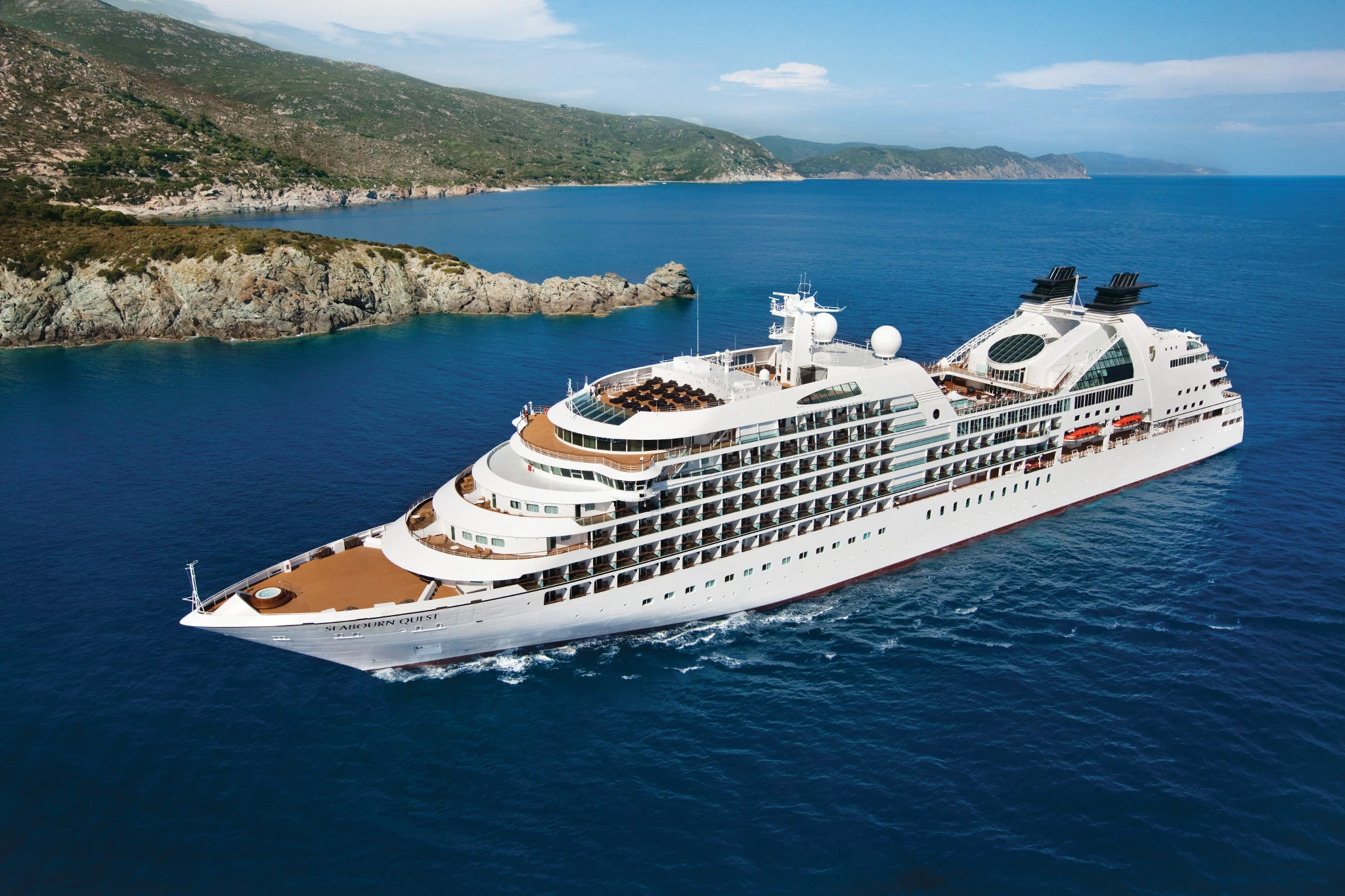
Seabourn Quest is the third iteration of the vessel design that has been called “a game-changer for the luxury segment.” True to her Seabourn bloodlines, wherever she sails around the world, Seabourn Quest carries with her a bevy of award-winning dining venues that are comparable to the finest restaurants to be found anywhere. Seabourn Quest offers a variety of dining options to suit every taste and every mood, with never an extra charge.
Internet Cafe
Bar
Mariners Patio Bar
Patio Grill
Patio Lounge
Sky Bar
The Colonnade
The Grill (burgers & hot dogs)
The Restaurant
The Restaurant 2
Living Room
Shopping Gallery
Fitness Center
Gym
Wellness Centre
Greenhouse Spa & Salon
Massage
Spa
Swimming Pool
Whirlpool
Casino
Entertainment Team
Gaming Club Casino
Theatre
9-hole Mini Golf
Card Room
Library
Water Sports Marina
Please complete the form below