
Please complete the form below



Denmark’s capital is arguably one of the world’s best-loved cities, and certainly the liveliest of all the Scandinavian capitals. It is a gracious and comfortable place, with a decidedly friendly, hospitable and fun-loving atmosphere. If there is such a thing as a cozy city, Copenhagen is it. From the lingering memory of the tales of Hans Christian Andersen to the colored lights of Tivoli Gardens, there is a delightful ambience that surrounds the visitor everywhere. Tidy, narrow streets are lined with tempting restaurants and cafes, and the pedestrian-only Stroget abounds with stylish shops. The spirited Copenhageners are imaginative and unconventional and exude a “do-what-you-want” philosophy that embraces and respects almost all aspects of life. Every friendly Dane you meet further illustrates the city’s motto “Wonderful, wonderful, Copenhagen.”
At the tip of the flat, sandy Jutland peninsula, Skagen is Denmark’s northernmost town and a popular holiday destination for Danes. It was long Denmark’s most important fishing port, but its popularity as a recreation area began at the end of the 19th Century when Queen Alexandrine, the wife of King Christian X, fell in love with the rustic character of the place and built the summer residence Klitgaarden. The royal couple invited other Scandinavian and European royalty to share holidays with them and Skagen’s reputation grew. At the same time, the Skagensbanen railway made travel to Jutland easier. Impressionist artists were attracted by the exotic sand- and seascapes and the vivid light reflected from the sea, and a school of Skagen Painters thrived in the first quarter of the 20th century. Arts and crafts still remain an important local tradition, and the town has many shops and galleries offering handmade goods to visitors. There is a venerable lighthouse near the peninsula’s tip, where the North Sea and the Baltic Sea meet, but due to their differing densities, their margins can clearly be seen. A St. Lawrence’s Church was built in Skagen in the 14th century, but it was eventually inundated by drifting sand dunes. The Skagen Church of today was built in 1841.
Farsund is located on the Lista Peninsula in southern Norway, which is filigreed with fjords and waterways such as the Lygdalsfjorden. It is a popular attraction for vacationers for its beaches and prolific birdlife, as well as hiking trails and historic events such as the pirate festival. The Vanse Church is one of Norway’s earliest, dating from 1037. The town was also an important part of the Atlantic Wall in WWII, with bunkers and fortifications such as the Nordberg Fortress, and nearby islands used as prisons for captured Axis soldiers. The Lista Lighthouse is a popular place to watch birds and get views over the beaches.
A Romanesque cathedral and old medieval lanes blend beautifully with Stavanger’s modern city and spectacular countryside. In 872, when Harald Fairhair won the Battle of Hafrsfjord near Stavanger, he united Norway for the first time. Huge harvests of brisling, herring and sardines have made the key of a sardine can the city symbol. Today, the town is the center of Norway’s oil industry, and has become one of the country’s most cosmopolitan cities.
Lerwick, Britain’s most northerly town, and is a small, bustling, cosmopolitan seaport with a population of over 7,000 people and fine architecture. Shetland Museum, located on Hay’s Dock, is an award- winning attraction. Discover the island’s many secrets through its exhibits, and take a look in the boat shed, where you can see demonstrations of traditional boat building. Also of interest is the stone-walled town hall, built in 1884, displaying an impressive array of beautifully intricate stained glass. Towering St. Magnus Cathedral, constructed in 1863, is likewise well worth a visit.
People have lived and prospered here since Neolithic times. The site of Clickimin Broch, a hollow-stone-walled structure, was a Late Bronze Age farmstead of the 7th century BCE. Historic Fort Charlotte, built in 1653, is a five-sided fortress, with cannon batteries pointing out to sea. The Shetland Textile Museum, with its fine weaving, and the quaint Crofters Museum will detail life in a much gentler time. The name Lerwick is derived from Norse and means ‘bay of clay.’
A distant outpost of Denmark, the Faroe Islands suddenly appear out of the misty North Atlantic, nearly 200 miles from the nearest landfall. Of the twenty-two islands in the group, seventeen are inhabited, with a population of 17,000 residing in the capital city of Torshavn. Irish monks discovered the islands in the 8th century and became the first settlers, only to be driven out by Viking explorers a century later. The traditions and legends of their Viking forefathers are kept alive in a language so close to old Norse that Faroe Islanders can still read the ancient texts inscribed centuries ago. The name Faroe comes from faereyjar, the Old Norse word meaning “Sheep Islands.” With thousands of sheep dotting the hillsides, the name remains apt today. While sheep are important to the economy, the real wealth of the islands comes from the fishing industry. A fleet of over 300 trawlers and line-fishing boats bring in an average annual haul of 245,000 tons of cod and herring. Ultra-modern processing and freezing plants do the job of getting the product to market in the most efficient manner.
A distant outpost of Denmark, the Faroe Islands suddenly appear out of the misty North Atlantic, nearly 200 miles from the nearest landfall. Of the twenty-two islands in the group, seventeen are inhabited, with a population of 17,000 residing in the capital city of Torshavn. Irish monks discovered the islands in the 8th century and became the first settlers, only to be driven out by Viking explorers a century later. The traditions and legends of their Viking forefathers are kept alive in a language so close to old Norse that Faroe Islanders can still read the ancient texts inscribed centuries ago. The name Faroe comes from faereyjar, the Old Norse word meaning “Sheep Islands.” With thousands of sheep dotting the hillsides, the name remains apt today. While sheep are important to the economy, the real wealth of the islands comes from the fishing industry. A fleet of over 300 trawlers and line-fishing boats bring in an average annual haul of 245,000 tons of cod and herring. Ultra-modern processing and freezing plants do the job of getting the product to market in the most efficient manner.
Like most Icelandic towns, this one on the northwest coast was started by fisherman and whalers. The name means ice-fjord. It is a perfect place from which to explore the cultural and economic staples of Iceland. An excursion to Sudavik reveals a town started by whalers and nearly destroyed by an avalanche in 1995, now rebuilt out of the path of further slides. Its lovely church was donated by whalers, as well. The own also holds a center for the study of the indigenous arctic foxes. The Maritime Museum in Isafjordur illustrates the lifestyles of the early inhabitants, including many implements of their trades, and also a wall of accordions, one of the few forms of entertainment on bygone days. Another option is a boat ride to nearby Vigur island, a nesting site for many species of seabirds, including eider ducks, whose down is yet another example of local economy based on the surrounding seas.
Warmed by the Gulf Stream as well as by highly active thermal hot springs and volcanoes, Iceland is somewhat misnamed. While it is a stark and barren country with three huge areas of glaciers, one theory is that early Norsemen sought to mislead other potential settlers by giving a pleasant name to fierce, inhospitable Greenland, and a forbidding name to the imminently habitable Iceland. Irish monks and hermits established themselves here in the 8th century, but left a century later when the pagan Norsemen arrived. Europe’s first Parliament of General Assembly, the Althing, was established in the year 930 and still functions as the legislative body, although it was suspended by the Danes at the end of the 18th century and not reconvened until 1843. Reykjavik was the site picked by the island’s first permanent resident, Ingolfur Arnarson in 874, and is home to more than half of the island’s total population. The world’s northernmost capital, Reykjavik is proud of its virtual lack of air pollution. Both electrical power and home heating are derived from the geothermal activity on the island. The city’s large swimming pools are always warm, and in the countryside exotic fruits such as grapes and bananas are cultivated in greenhouses made cozy with the help of underground hot springs.
The charming small fishing village of Grundarfjörður is located in the middle of the Snæfellsnes Peninsula and thus provides easy access to Stykkishólmur, Snæfellsbær and the Snæfellsnes National Park. Its best-known landmark is undoubtedly the peak of Mt. Kirkjufell. Translated as ‘church mountain,’ Kirkjufell is the most easily recognizable peak, and one of the most photographed mountains in Iceland. During summer months a Viking Village is built in the center of town where Viking re-enactments occur quite regularly. During the Á góðri stund town festival in July, the town’s 900 residents decorate their houses in red, blue, yellow, and green, transforming the town into a spinning kaleidoscope of color.
The town first began trade in 1786, and around 1800, French merchants came to Iceland and settled in Grundarfjörður, where they constructed a church and a hospital. The town has prospered through the fishing industry for a long time. The surrounding sea is rich with birdlife & marine life throughout the year.
The immense scale of the peaks around this village dwarfs anything built there. Still, the tall white steeple of the church juts up with a spirit of endurance and perseverance that matches the character of those who make this arctic outpost their home. It also echoes the shape of icebergs floating in the surrounding seas, shed from the immense icefields that cover much of the island.
This fishing town is situated on a low-lying peninsula backed by towering black volcanic mountains. There are no shore excursions available for Paamiut, and guests will no doubt enjoy walking into the town and visiting the beautiful church, which is reminiscent of the stave churches of Norway and boasts excellent acoustics. The local museum has photos of the whaling history, and examples of local arts and crafts, which are also offered for sale in the town. The town is the hub of numerous thousand-year old paths leading into the countryside. If the weather is good, guests might wish to take one of these for a while to get the feel of the place. Keep a sharp eye out for whales in the sea, and sea eagles in the sky or on the peaks.
Greenland’s capital boasts some 16,000 inhabitants. Although the town does not offer us any shore excursions, there are several attractions which guests may wish to visit. One is the roofed town market, where the products of the nearby sea and wilderness are for sale, including the meat of whales, seals, birds and fish. The Katuaq Cultural Center offers changing exhibitions. Especially worth a visit is the National Museum, which besides many historic objects, contains the quite famous 500-year old mummies recovered from Qilakitsoq. The nearby Museum of Art has works by both Inuit and Nordic artists. There is also an artisan’s center where guests may purchase locally produced works, and a collection of traditional houses.
Located at the most northerly tip of Newfoundland, L’Anse aux Meadows is nestled near the fishing village of St. Anthony. It is the site of the first European settlement in the New World, approximately 500 years before Columbus’ arrival. Other Norse groups had relocated from their homelands to the New World. In 1961, explorer and writer Helge Instad discovered a group of large mounds in the countryside. These mounds were excavated revealing the remains of a Norse settlement. This site became L’Anse aux Meadows National Historic Park in 1977 and is noted on the UNESCO World Heritage List of important cultural properties. The site at L’Anse aux Meadows has been completely excavated allowing visitors to see the remains of the homes, a smithy, and various worksheds. The park’s interpretive center displays Norse artifacts from the excavation which include iron rivets, a flywheel and the floorboard of a boat. Researchers still debate as to whether the site at L’Anse aux Meadows is Leif Eriksson’s ‘Vinland,’ a lush, beautiful area where he settled in for the winter around the year 1000. Parks Canada will greet you on disembarking the ship and you may explore at leisure this first settlement of the New World.
At the tip of Quebec’s southern peninsula, in the heart of the Gulf of St. Lawrence, Gaspé is like a remnant of Brittany marooned on the North American continent. Charming fishing villages, lighthouses and marine vistas abound. Nearby Percé Rock is a huge stone arch stuck into the sea, and offshore, Bonaventure Island hosts the largest nesting colony of gannets in the world.
Located on the North Shore of the St. Lawrence River northeast of Quebec, this town was born of the forest and river resources and still thrives on them. Timber and paper production. hydroelectric power from two huge dams and aluminum smelting are the mainstays. Explore the boreal forest, its wildlife and the geology of the Laurentian Shield in displays and in person.
Founded in 1608 as a fur-trading base by Samuel de Champlain, Québec has a long and exciting history. In 1759, the English defeated the French on the Plains of Abraham and helped determine the outcome of the French and Indian Wars, which under the Treaty of 1763, established British supremacy in Canada. The joie de vivre and panache, however are totally French, as are the cuisine, language and heritage. The first buildings were close to the St. Lawrence waterfront and are known as Lower Town. Most hotels are on a hill that rises steeply from the river in what today is called Upper Town. Québec is still North America’s only walled city north of Mexico. Handsome old structures throughout the city are fine examples of classical French architecture. The towers and spire of the imposing Château Frontenac Hotel, built by the Canadian and Pacific Railway in 1892, lend the city an aura of the Belle Epoque.
Montreal, an island city of approximately three million people, claims to be the largest French-speaking city outside of Paris. It was here in 1535 that Jacques Cartier, the first European to explore the St. Lawrence River, founded a small settlement on the island. This settlement failed, so the official founding date of the city is May 1642. In modern days, Expo ’67 and the Summer Olympics of 1976 brought hundreds of thousands of visitors to Montreal. Major conventions, film festivals and cultural events are held in Montreal, attracted by the city’s extensive facilities, fine hotels and excellent dining.
Havre-Saint-Pierre (Harbour St. Pierre in English), is a small town of 3,300 inhabitants, situated along Quebec’s North Shore. To the south is Anticosti Island and the great expanse of the Gulf of St. Lawrence. It was settled in 1857 by six Acadian-French families originally from the Îles de la Madeleine. Here they found a land rich in lumber and a sea rich in fish. Today’s inhabitants speak a dialect of Acadian French different from the French spoken in the rest of the Province of Quebec.
Havre-Saint-Pierre is the jumping-off point to explore a dozen picturesque fishing villages, seabird colonies, marine wildlife concentrations and the beautiful Mingan Archipelago National Park Reserve. The shoreline of the Mingan Archipelago is a wonderland of sculpted limestone pinnacles and outcroppings. Eroded by thousands of years of wind and waves, the limestone forms are the largest group of such monoliths in Canada. The most recognizable limestone pillar in the park is called La Grande Dame (The Great Lady).
Red Bay is a National Historic Site of Canada, and has been nominated by Canada for inclusion as a UNESCO World Heritage Site. One of the reasons is the importance of the Basque whaling activity that thrived here in the 16th and early 17th centuries. Sunken Basque galleons and smaller boats from the period have been discovered just offshore. Although the whale population is much diminished today, it is still a popular activity to watch them, as well as the icebergs that float down from the seas further north.
Anthony of Padua or Anthony of Lisbon was a Portuguese Catholic priest and friar of the Franciscan Order. He was born and raised by a wealthy family in Lisbon, Portugal, and died in Padua, Italy.
St. John’s is the most easterly point in North America and closest point of land to Europe. Due to it strategic location, St. John’s has been vitally important for centuries to explorers, adventurers, merchants, soldiers, pirates, and all manner of seafarers, who provided the foundation for this thriving modern day city. Explore this, one of the oldest cities in North America, and a city unlike any other. This “City of Legends” is cradled in a harbor carved from granite, and surrounded by hills running down to the ocean. Quaint side streets of a thousand colors are home to friendly faces that wait to greet you.
St. John’s is the most easterly point in North America and closest point of land to Europe. Due to it strategic location, St. John’s has been vitally important for centuries to explorers, adventurers, merchants, soldiers, pirates, and all manner of seafarers, who provided the foundation for this thriving modern day city. Explore this, one of the oldest cities in North America, and a city unlike any other. This “City of Legends” is cradled in a harbor carved from granite, and surrounded by hills running down to the ocean. Quaint side streets of a thousand colors are home to friendly faces that wait to greet you.
Saint Pierre and Miquelon is a French archipelago south of the Canadian island of Newfoundland. Sparsely populated Miquelon-Langlade island contains the Grand Barachois lagoon, home to seabirds and seals. The busier Saint Pierre island has a distinct French atmosphere, with a cathedral and the Musée Heritage, which celebrates regional history. An island nearby, Île-aux-Marins, features an abandoned fishing village.
This island in the archipelago in the Gulf of St. Lawrence offers scenic fishing villages and wind- and water-sculpted coastlines of eerie beauty. The church of St. Pierre at Laverniere was constructed from the wreckage of ships that foundered on the offshore shoals. A lighthouse now warns others away.
At the tip of Quebec’s southern peninsula, in the heart of the Gulf of St. Lawrence, Gaspé is like a remnant of Brittany marooned on the North American continent. Charming fishing villages, lighthouses and marine vistas abound. Nearby Percé Rock is a huge stone arch stuck into the sea, and offshore, Bonaventure Island hosts the largest nesting colony of gannets in the world.
Founded in 1608 as a fur-trading base by Samuel de Champlain, Québec has a long and exciting history. In 1759, the English defeated the French on the Plains of Abraham and helped determine the outcome of the French and Indian Wars, which under the Treaty of 1763, established British supremacy in Canada. The joie de vivre and panache, however are totally French, as are the cuisine, language and heritage. The first buildings were close to the St. Lawrence waterfront and are known as Lower Town. Most hotels are on a hill that rises steeply from the river in what today is called Upper Town. Québec is still North America’s only walled city north of Mexico. Handsome old structures throughout the city are fine examples of classical French architecture. The towers and spire of the imposing Château Frontenac Hotel, built by the Canadian and Pacific Railway in 1892, lend the city an aura of the Belle Epoque.
Montreal, an island city of approximately three million people, claims to be the largest French-speaking city outside of Paris. It was here in 1535 that Jacques Cartier, the first European to explore the St. Lawrence River, founded a small settlement on the island. This settlement failed, so the official founding date of the city is May 1642. In modern days, Expo ’67 and the Summer Olympics of 1976 brought hundreds of thousands of visitors to Montreal. Major conventions, film festivals and cultural events are held in Montreal, attracted by the city’s extensive facilities, fine hotels and excellent dining.
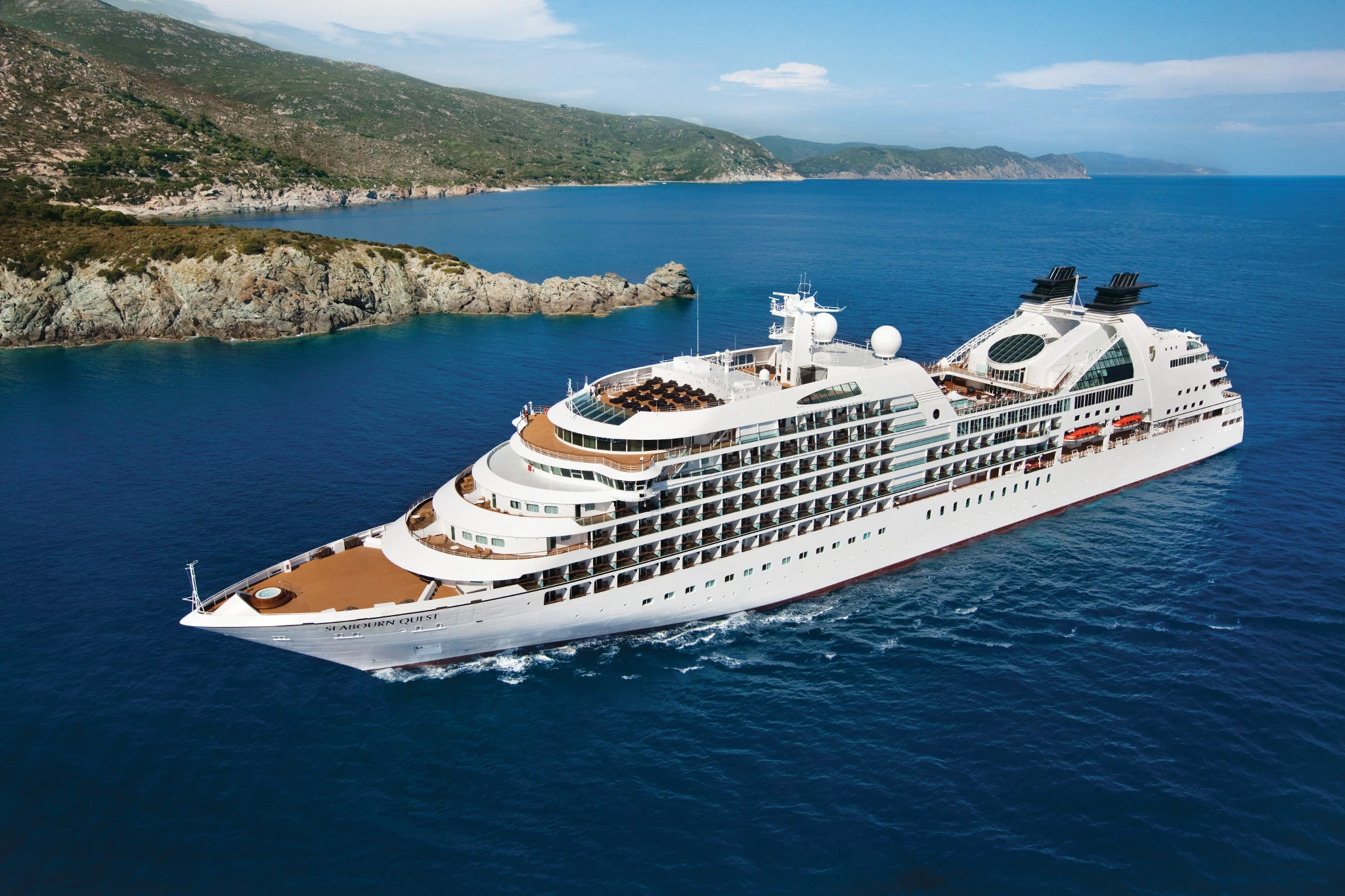
Seabourn Quest is the third iteration of the vessel design that has been called “a game-changer for the luxury segment.” True to her Seabourn bloodlines, wherever she sails around the world, Seabourn Quest carries with her a bevy of award-winning dining venues that are comparable to the finest restaurants to be found anywhere. Seabourn Quest offers a variety of dining options to suit every taste and every mood, with never an extra charge.
Internet Cafe
Bar
Mariners Patio Bar
Patio Grill
Patio Lounge
Sky Bar
The Colonnade
The Grill (burgers & hot dogs)
The Restaurant
The Restaurant 2
Living Room
Shopping Gallery
Fitness Center
Gym
Wellness Centre
Greenhouse Spa & Salon
Massage
Spa
Swimming Pool
Whirlpool
Casino
Entertainment Team
Gaming Club Casino
Theatre
9-hole Mini Golf
Card Room
Library
Water Sports Marina
Please complete the form below