
Please complete the form below


Miyako Island is 300 km south of Okinawa island, and is famous for its beaches, said to be Japan’s most beautiful. Maehama beach is for swimmers, while Yoshino has great coral reefs for snorkelers and the white-sand Sunayama has dramatic rock formations. Cape Higashi-Hennazaki is a long, narrow cape with the picturesque lighthouse at the end. The city’s Botanical Garden boasts over 1600 tropical varieties. Nakasone Tuyumya was an important leader of Miyako and the Okinawan people in the 16th century. Near the port in Hirara is memorial to him and his descendants, a designated national cultural asset. At the island’s north end, the graceful Ikema Ohashi bridge leads to the small Ikema Island.
This important port on Japan’s northern Hokkaido Island was the first to be opened to European and American trade. The result of this is a trove of Western-style buildings in the suburb of Motomachi that gives the impression of a movie set. The bell of the distinctive Haristo Greek Orthodox church is designated one of Japan’s official treasured “100 soundscapes.” Hokkaido is famous for its hot springs, much beloved by the Japanese. Yunokawa Hot Spring enjoys a commanding view of the sea, and its botanical garden is home to the Japanese macaques called “snow monkeys” because of their habit of soaking in the hot springs during the northern winter. Goryokaku is a 150-year old star fortress that holds the Magistrate’s Office, an excellent example of traditional Japanese architecture. Get a panoramic view from the observation platform atop the Goryokaku Tower.
This port on Japan’s northern island of Hokkaido thrived on coal exports and the herring fishery through the end of the 19th and the early 20th centuries, evidenced by the Western influenced “herring mansions” that line its central canal. The 1897 Nishin Goten is an early example, while the Aoyama Villa from 1924 is a later version. The 1912 Bank of Japan Museum is also influenced by Western taste, but nods to tradition with keystones representing owls, an ancient Ainu deity. Further afield, explore the Yoichi Nikka Whisky Distillery, the spas at the Jyozankei Hot Springs, or the Hokkaido coast as seen from the Cape Kanui Lighthouse. Any visit to Sapporo should include the mile-long Odoro Park.
This port on Japan’s northern island of Hokkaido thrived on coal exports and the herring fishery through the end of the 19th and the early 20th centuries, evidenced by the Western influenced “herring mansions” that line its central canal. The 1897 Nishin Goten is an early example, while the Aoyama Villa from 1924 is a later version. The 1912 Bank of Japan Museum is also influenced by Western taste, but nods to tradition with keystones representing owls, an ancient Ainu deity. Further afield, explore the Yoichi Nikka Whisky Distillery, the spas at the Jyozankei Hot Springs, or the Hokkaido coast as seen from the Cape Kanui Lighthouse. Any visit to Sapporo should include the mile-long Odoro Park.
Busan is the second largest city in South Korea, and the country’s seaside connection to Japan and the West. Lovely urban scenery, the Pusan International Film Festival, and near-by hot springs has made Busan a popular leisure destination. Busan has the sophistication of a major city, as well as famous beaches that lure visitors from all over the world. The city is a microcosm of South Korea, a nation whose economic success often obscures, to Westerners, one of Asia’s most sophisticated and venerable cultures.
Jeju (Cheju) Island is a volcanic island, dominated by Halla-san (Halla Mountain), a volcano 6,398 feet high and the tallest mountain in South Korea. The island was created entirely from volcanic eruptions approximately 2 million years ago. Because of the relative isolation of the island, the people of Jeju have developed a culture and language that are distinct from those of mainland Korea. The most distinct cultural artifact is the ubiquitous dol hareubang (“stone grandfather”) carved from a block of lava. Jeju translates to “Island of the Gods” and lives up to its name with beautiful beaches, waterfalls and volcanic rock formations.
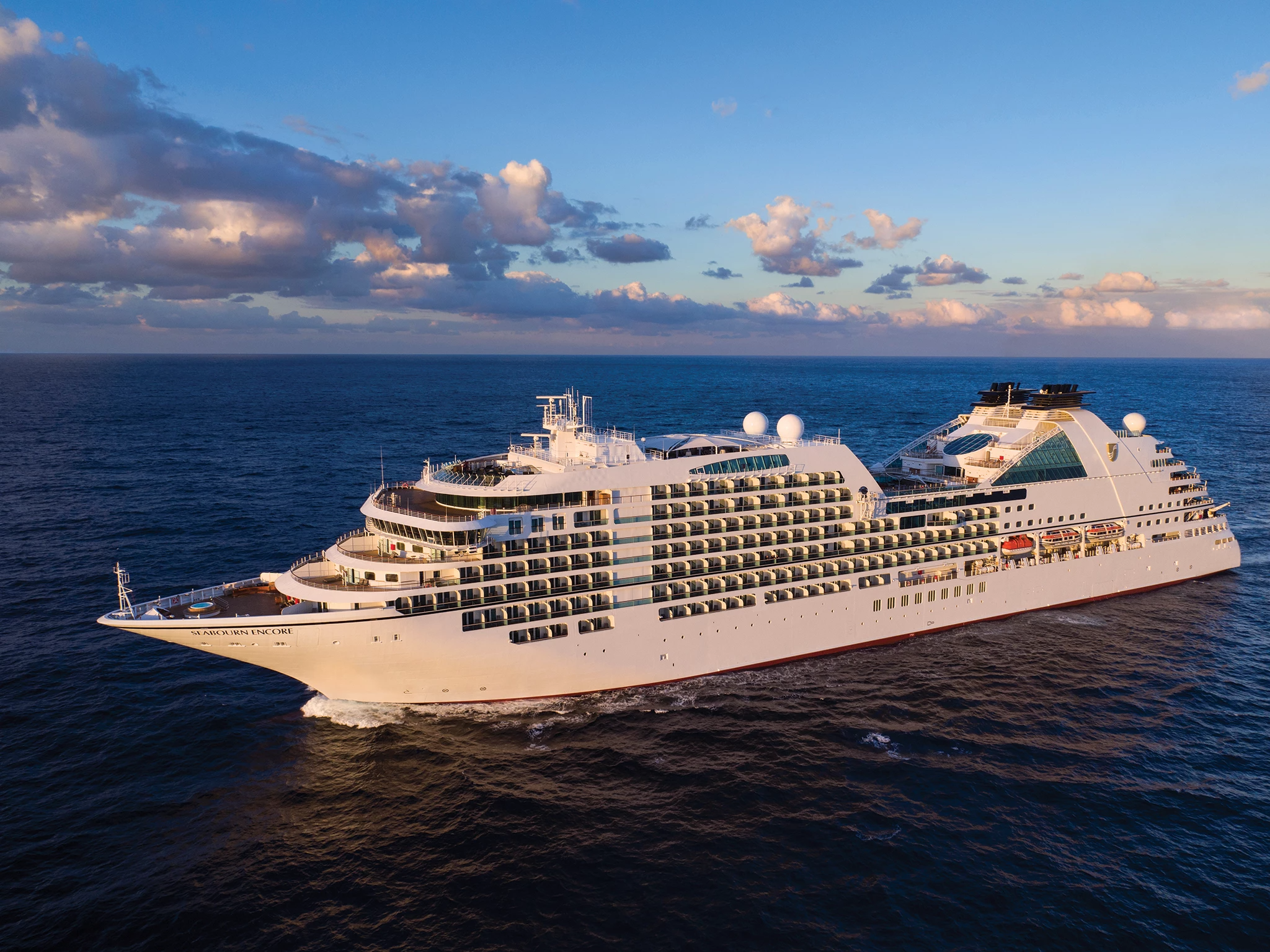
Seabourn Encore is as strikingly beautiful and as excitingly innovative as any Seabourn has ever debuted. She crowns a fleet of luxury cruise ships that is already the newest, most modern and most acclaimed in the ultra-luxury segment. Modeled on the award-winning trio of ships introduced with Seabourn Odyssey, Seabourn Encore represents another welcome stage in the evolution of small ship cruising, which Seabourn pioneered and has consistently expanded and enriched for all of our small ship cruises.
Couples Treatment Room
Spa
Sun Terrace
Swimming Pool
The Retreat
Whirlpool
Bar
Coffee Bar
Restaurant
Sky Bar
Sushi Bar
The Colonnade
Casino
Gaming Club Casino
Photo Gallery
Theatre
Internet Cafe
Conference Room
Elevator
Medical Centre
Shops
Fitness Center
Gym
Wellness Centre
Card Room
Library
Please complete the form below