
Please complete the form below



Montreal, an island city of approximately three million people, claims to be the largest French-speaking city outside of Paris. It was here in 1535 that Jacques Cartier, the first European to explore the St. Lawrence River, founded a small settlement on the island. This settlement failed, so the official founding date of the city is May 1642. In modern days, Expo ’67 and the Summer Olympics of 1976 brought hundreds of thousands of visitors to Montreal. Major conventions, film festivals and cultural events are held in Montreal, attracted by the city’s extensive facilities, fine hotels and excellent dining.
Havre-Saint-Pierre (Harbour St. Pierre in English), is a small town of 3,300 inhabitants, situated along Quebec’s North Shore. To the south is Anticosti Island and the great expanse of the Gulf of St. Lawrence. It was settled in 1857 by six Acadian-French families originally from the Îles de la Madeleine. Here they found a land rich in lumber and a sea rich in fish. Today’s inhabitants speak a dialect of Acadian French different from the French spoken in the rest of the Province of Quebec.
Havre-Saint-Pierre is the jumping-off point to explore a dozen picturesque fishing villages, seabird colonies, marine wildlife concentrations and the beautiful Mingan Archipelago National Park Reserve. The shoreline of the Mingan Archipelago is a wonderland of sculpted limestone pinnacles and outcroppings. Eroded by thousands of years of wind and waves, the limestone forms are the largest group of such monoliths in Canada. The most recognizable limestone pillar in the park is called La Grande Dame (The Great Lady).
Red Bay is a National Historic Site of Canada, and has been nominated by Canada for inclusion as a UNESCO World Heritage Site. One of the reasons is the importance of the Basque whaling activity that thrived here in the 16th and early 17th centuries. Sunken Basque galleons and smaller boats from the period have been discovered just offshore. Although the whale population is much diminished today, it is still a popular activity to watch them, as well as the icebergs that float down from the seas further north.
Anthony of Padua or Anthony of Lisbon was a Portuguese Catholic priest and friar of the Franciscan Order. He was born and raised by a wealthy family in Lisbon, Portugal, and died in Padua, Italy.
St. John’s is the most easterly point in North America and closest point of land to Europe. Due to it strategic location, St. John’s has been vitally important for centuries to explorers, adventurers, merchants, soldiers, pirates, and all manner of seafarers, who provided the foundation for this thriving modern day city. Explore this, one of the oldest cities in North America, and a city unlike any other. This “City of Legends” is cradled in a harbor carved from granite, and surrounded by hills running down to the ocean. Quaint side streets of a thousand colors are home to friendly faces that wait to greet you.
St. John’s is the most easterly point in North America and closest point of land to Europe. Due to it strategic location, St. John’s has been vitally important for centuries to explorers, adventurers, merchants, soldiers, pirates, and all manner of seafarers, who provided the foundation for this thriving modern day city. Explore this, one of the oldest cities in North America, and a city unlike any other. This “City of Legends” is cradled in a harbor carved from granite, and surrounded by hills running down to the ocean. Quaint side streets of a thousand colors are home to friendly faces that wait to greet you.
Saint Pierre and Miquelon is a French archipelago south of the Canadian island of Newfoundland. Sparsely populated Miquelon-Langlade island contains the Grand Barachois lagoon, home to seabirds and seals. The busier Saint Pierre island has a distinct French atmosphere, with a cathedral and the Musée Heritage, which celebrates regional history. An island nearby, Île-aux-Marins, features an abandoned fishing village.
This island in the archipelago in the Gulf of St. Lawrence offers scenic fishing villages and wind- and water-sculpted coastlines of eerie beauty. The church of St. Pierre at Laverniere was constructed from the wreckage of ships that foundered on the offshore shoals. A lighthouse now warns others away.
At the tip of Quebec’s southern peninsula, in the heart of the Gulf of St. Lawrence, Gaspé is like a remnant of Brittany marooned on the North American continent. Charming fishing villages, lighthouses and marine vistas abound. Nearby Percé Rock is a huge stone arch stuck into the sea, and offshore, Bonaventure Island hosts the largest nesting colony of gannets in the world.
Founded in 1608 as a fur-trading base by Samuel de Champlain, Québec has a long and exciting history. In 1759, the English defeated the French on the Plains of Abraham and helped determine the outcome of the French and Indian Wars, which under the Treaty of 1763, established British supremacy in Canada. The joie de vivre and panache, however are totally French, as are the cuisine, language and heritage. The first buildings were close to the St. Lawrence waterfront and are known as Lower Town. Most hotels are on a hill that rises steeply from the river in what today is called Upper Town. Québec is still North America’s only walled city north of Mexico. Handsome old structures throughout the city are fine examples of classical French architecture. The towers and spire of the imposing Château Frontenac Hotel, built by the Canadian and Pacific Railway in 1892, lend the city an aura of the Belle Epoque.
Montreal, an island city of approximately three million people, claims to be the largest French-speaking city outside of Paris. It was here in 1535 that Jacques Cartier, the first European to explore the St. Lawrence River, founded a small settlement on the island. This settlement failed, so the official founding date of the city is May 1642. In modern days, Expo ’67 and the Summer Olympics of 1976 brought hundreds of thousands of visitors to Montreal. Major conventions, film festivals and cultural events are held in Montreal, attracted by the city’s extensive facilities, fine hotels and excellent dining.
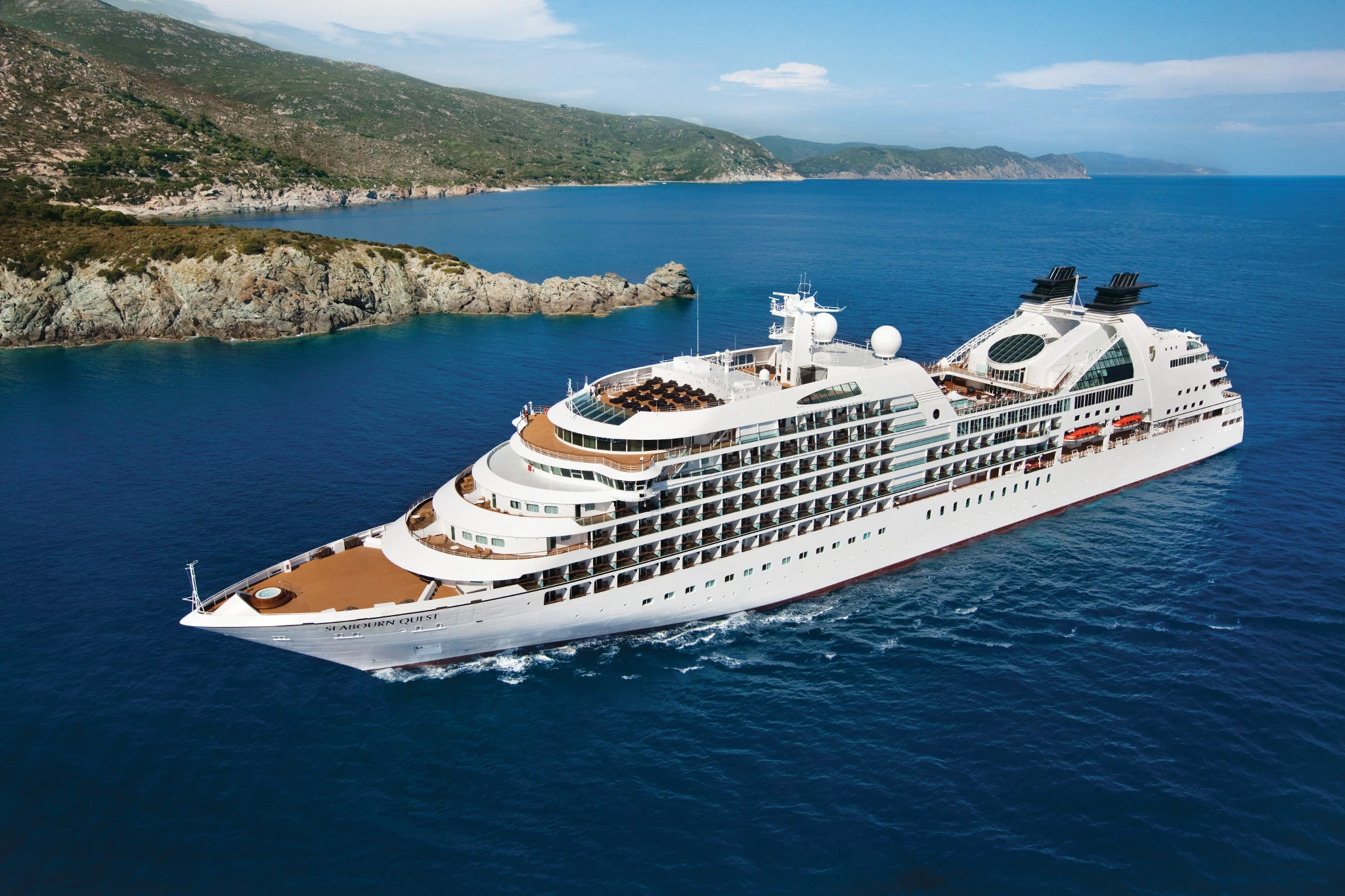
Seabourn Quest is the third iteration of the vessel design that has been called “a game-changer for the luxury segment.” True to her Seabourn bloodlines, wherever she sails around the world, Seabourn Quest carries with her a bevy of award-winning dining venues that are comparable to the finest restaurants to be found anywhere. Seabourn Quest offers a variety of dining options to suit every taste and every mood, with never an extra charge.
Internet Cafe
Bar
Mariners Patio Bar
Patio Grill
Patio Lounge
Sky Bar
The Colonnade
The Grill (burgers & hot dogs)
The Restaurant
The Restaurant 2
Living Room
Shopping Gallery
Fitness Center
Gym
Wellness Centre
Greenhouse Spa & Salon
Massage
Spa
Swimming Pool
Whirlpool
Casino
Entertainment Team
Gaming Club Casino
Theatre
9-hole Mini Golf
Card Room
Library
Water Sports Marina
Please complete the form below